From Visibility to Valuation
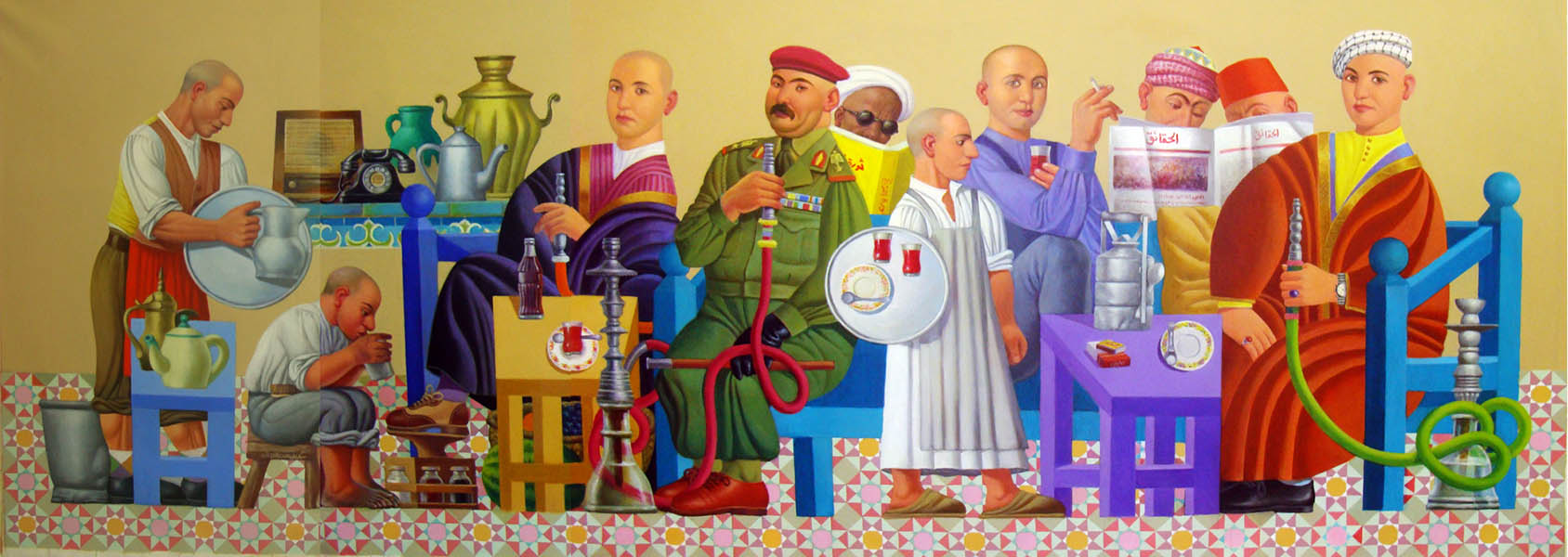
The Cafe 2 by Iraqi artist Faisal Laibi Sahi seats Baghdad's society on a single bench: a custodian, a shoeshine boy, a man at leisure with a hookah, a lieutenant, a mullah lost in a book, a young tea-server, a tarboosh and a taqiyah touching to share a newspaper. Class, labor, faith, and authority arranged across one horizontal canvas in vivid contemporary color. Hierarchy in the artwork is not architectural but optical; study their eyes. Sahi offers them the same room and the same flat backdrop, then ranks them through gaze.
This month's issue places two writing samples of independent bachelor-level research in conversation.
Both pieces of research in this issue complicate uniquely relevant phenomena in today's art world. One asks who is seen. The other asks how they are seen.
Mona Kilani studies What the Rise of Gulf Art Patronage Means for Levant Fine Arts. Her work examines Instagram as a mediating effect on visibility, democratization, and cultural expression in the Levant–Gulf context. Through a mixed-methods approach combining survey data, semi-structured interviews, and content analysis around Art Basel Qatar 2026, she finds that even in a digitized world, Instagram remains a conduit of connection and opportunity rather than the place where fine art will ever live.
Soraya Camperio asks what determines the hammer price of a contemporary artwork at auction, and whether the observable attributes of a painting hold any explanatory weight once artist reputation is accounted for. Her findings, drawn from 419 sales at Christie's, Sotheby's, and Phillips between 2010 and 2024, conclude that the painting is the occasion, and the name is the price.
THE PIPELINE
Excerpted from What the Rise of Gulf Art Patronage Means for Levant Fine Arts: Instagram as a Pipeline for Visibility, Democratization, and Cultural Expression by Mona Senan Zeid Kilani, IE University, Bachelor in Business Administration, 2026. Personal-communication interviews with all quoted individuals below were conducted by the author; each interviewee consented to the use of their name and role.
The human element of the contemporary art market does not happen digitally. It lives in the studio visits, the fair openings, the conversation in front of the work. Yet over the past decade, Instagram has become a dominant vehicle through which Levantine artists are most visibly entering Gulf patronage networks, opening the doors to discovery and discourse. What surfaced across sixty-five survey responses, six interviews, and a content study of Art Basel Qatar 2026 was something different. The platform is doing structural work, but not the work I expected. It is not where the art is sold. It is where the art becomes possible to consider. These are the voices that carried that finding.
“The big shift was the Instagram. The outreach became even more exposure outside Jordan, our borders.”
Lallas has spent two decades representing Jordanian artists at Wadi Finan. During these years she's dealt with fairs, foundations, and museums across the Gulf. She watched the institutional center of gravity shift again with Art Basel Qatar's inaugural Doha edition, deeming it “centralised, made a command centre in the Middle East.” Her gallery's reach transformed when Instagram arrived, and so did the structure of how artists become legible to that command centre. The platform let her artists be seen by foundations, curators, and collectors she had no prior way to reach. It also let those same actors contact her artists directly, around her. Lallas does not describe this as loss. She describes it as a redistribution of the cultural-heritage work she has been doing for twenty years. “There are platforms,” she said. “And many of them are selling platforms. But what you are saying is you are hitting on the cultural heritage. That's what we are missing.”
“We believe that liberation is coming. And we decided we're not only going to talk about Orientalism. We're going to dig deep in our roots. Palestinian roots, born and raised in Amman.”
Naqsh translates Palestinian embroidery patterns into stone, brass, and marble. Run by three sisters in partnership, Nisreen leads the Amman studio while her sister Nermeen leads Dubai, and the same signature carries across both cities and mediums. Their entry into Gulf institutional networks came through Dubai Design Week, which Abu-Dail described as the moment the practice shifted from the practical and organic into cultural arenas. Her framing of the work is structural and explicit: “It is more of a responsibility than an ego of a designer.” The work is not designed for the market it enters; the market is being asked to absorb a cultural commitment that was already in motion.
“If I didn't check Sultan Al Qassemi's stories and how he reposted Fire Station's post, I wouldn't have found out about this residency.”
The chain she described, a Sharjah-based collector reposting a Qatari institution's call and a Jordanian artist seeing it, is the pipeline in a single sentence. The work that traveled through that chain is built from regional sensory memory: sand, jasmine, pomegranates, held in Samman's framing as a form of resistance under conditions of displacement. The platform did not generate that work. It allowed the work to meet the institutional architecture that recognized it.
“Young collectors respond especially well to artworks that are grounded in a response to current events, such as Black Lives Matter, MeToo, conflict, or injustices.”
In May 2025, a Giacometti sculpture failed to sell at Sotheby's New York, with bidding stalling at sixty-four million dollars despite the work being the season's headline lot. Artnet read the moment as a softening of the trophy market and noted that younger collectors are buying differently: emerging artists, work engaged with cultural and political subjects, less interest in canonical names. The directional shift is real, and it is favorable to the work moving through the pipeline. The collectors entering this market are younger, more regional, and more interested in cultural weight, and that is exactly what the pipeline is delivering.
There is a gap inside this convergence. The platforms now active in the regional space are largely transactional. The cultural register Lallas named as missing is absent for a reason: it does not sell as cleanly as the work itself does. The pipeline has institutional architecture on the receiving end and digital infrastructure as its perceptual layer. What it does not have, in proportion to either, is editorial space for the work to be narrated on its own terms.
baqaya was built into that conversation. It joins a small but growing field of editorial spaces already reading Levantine and SWANA practice on its own terms, alongside the institutions placing the work and the platforms surfacing it. The pipeline is one half of the question this issue holds: how the work becomes visible. The other half, what happens once that visibility hardens into a price, is where Camperio's research picks up.
THE CEILING
Excerpted from Hedonic Determinants of Hammer Prices in the Contemporary Art Market: The Role of Artist Reputation, Physical Characteristics, and Market Institutions. Courtesy of Soraya Camperio, IE University, Bachelor in Economics, 2026. Numerical findings drawn from a hedonic regression analysis of 419 contemporary auction sales at Christie's, Sotheby's, and Phillips, 2010–2024, conducted independently by the author.
This research provides empirical proof that in the contemporary auction market, art's primary driver of price is reputation, and other attributes, such as physical and stylistic ones, play a secondary role.
The share of price variation explained once artist identity is controlled for in the hierarchical model.
Although physical characteristics do play a role, their effect remains modest. Larger works sell for more than small pieces, but size alone does not account for a large percentage of price differences. In contrast, the incorporation of artist-related variables substantially changes the explanatory structure of the model. Artists in the top tier tend to have higher coefficient values, and lower-tier artists are associated with strongly negative effects. The results imply that price is not simply a function of observable attributes, but rather a reflection of larger validation processes by institutions and the accumulation of symbolic capital and market recognition.
Typical auction price ranges by artist tier in the dataset.
The results reveal that stylistic attributes, such as abstraction, lose their statistical significance once artist-level effects are incorporated. Therefore, stylistic value is highly correlated with the number of well-reputed artists within that stylistic category. Logically, style does not behave as an independent determinant of value, but rather as a proxy for artist identity in simpler models.
Reputation emerges as a socially constructed mechanism, which is led by gallery representation, market performance, and critical dialogue, rather than the intrinsic property of the painting itself. Once reputation is established, it holds a self-reinforcing and persistent effect on price. This supports Baumol's characterisation of the art market as being a “floating crap game”, where price changes are difficult to predict based on the fundamentals of a painting alone.
The relatively modest significance of material and stylistic properties indicates that collectors prioritise artist identity over inherent attributes of the paintings, reinforcing the argument of art as both a consumption and positional good.
The artist-level effects in the findings provide strong empirical support for Rosen's superstar theory. According to this framework, markets defined by talent differentiation and asymmetric substitutability often show extreme concentration, where a small number of individuals weigh a disproportionate fraction of total revenue.
A small number of artists account for a disproportionately large share of total auction revenue.
Real-world evidence strongly encourages this interpretation. Auction results in the contemporary art market consistently show that a restricted selection of artists, such as Gerhard Richter, Christopher Wool, and Julie Mehretu, account for a disproportionately large portion of total revenue. These artists gain from institutional endorsement, global fame, and strong collector demand, allowing their works to attain prices far above those of less established artists.
This serves as further evidence for the dichotomous nature of the art market, wherein economic mechanisms operate alongside cultural and social processes of validation.
In Dialogue
The custodian looks at the tray. The shoeshine boy looks at the shoe. The noblemen gaze at each other or forward. The contemporary art ecosystems that the two studies concern behave homogeneously. Kilani traces who is afforded the chance to look up at all, and how that chance has shifted with the power of social media. Camperio traces what happens once the eyes have widened and the work is delivered into institutional view.
In light of the SWANA art world, the artist whose practice begins under a societal question mark, or marked by conflict, enters not a single market but a sequence of mediating layers, at once economic, social, and political, that decide, in turn, who is seen, who is recognized, and what the recognition is eventually worth.
This is the conversation baqaya exists to advance.